
Introduction
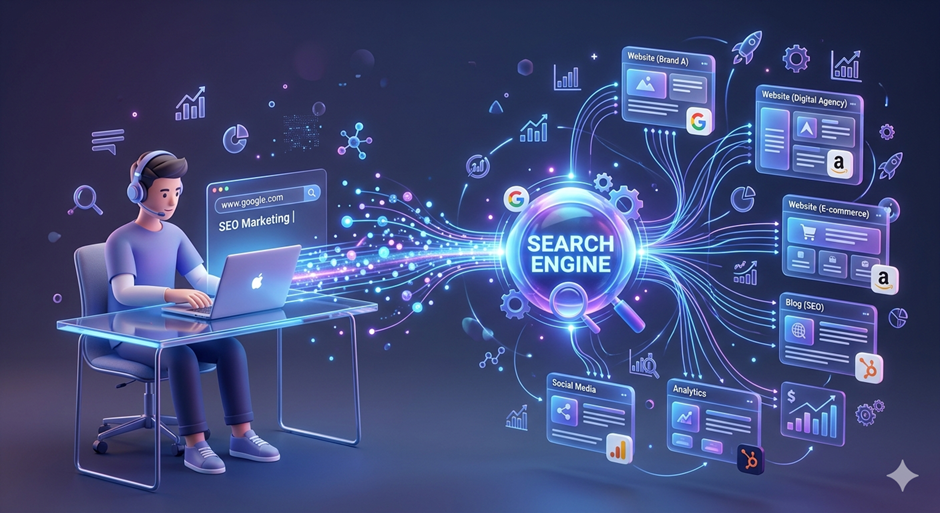
A few years ago, if someone wanted to find a product or service, they would ask friends or walk into nearby stores. Today, the first thing most people do is open a search engine like Google and type their question. Within seconds, they are shown hundreds of options but they usually click only on the top few results.
This shift in behavior has completely changed how businesses grow. It’s no longer just about having a website; it’s about being visible when your audience is actively searching. That’s where SEO (Search Engine Optimization) comes in. SEO helps your website appear in front of the right people at the right time, without relying only on paid ads.
Whether you’re a small business owner, a student, or someone exploring digital marketing, understanding SEO is essential. It’s not just a technical skill it’s a way of thinking about how people search, what they need, and how you can provide value through your content.
What is SEO in Digital Marketing
SEO (Search Engine Optimization) in digital marketing is the process of optimizing a website so that it ranks higher on search engine results pages (SERPs) when users search for relevant queries. It focuses on improving different aspects of a website such as content, structure, and technical performance to make it more appealing to both users and search engines.
In today’s digital landscape, search engines like Google act as the primary gateway between users and information. SEO ensures that your website becomes part of that journey.
Rather than interrupting users with ads, SEO works by aligning your content with what people are already searching for. For example, if someone searches for “best digital marketing tips,” SEO helps your content appear as a helpful solution to that query.
At its core, SEO is not just about ranking it’s about delivering the right content to the right audience at the right time.
Why This Guide the Best Solution?
There’s no shortage of SEO advice online but much of it is either too technical, outdated, or scattered. This guide is designed to solve that problem by offering a clear, practical, and beginner-friendly roadmap.
Here’s why this approach works better:
1. Simplified Yet Complete
Instead of overwhelming you with jargon, this guide breaks SEO into easy-to-understand concepts while still covering everything you need to know.
2. Focused on real results
This isn’t just theory. The strategies shared here are focused on what actually works today helping you improve visibility, traffic, and conversions.
3. Structured for action
Many guides explain SEO but don’t tell you what to do next. This guide is structured to help you learn → apply → improve, step by step.
4. Beginner to intermediate friendly
Whether you’re a student, business owner, or aspiring marketer, this guide helps you build a strong foundation without confusion.
5. Long-Term Perspective
SEO is not about quick hacks. This guide focuses on sustainable growth strategies that continue to deliver results over time.
In short, this guide acts as a practical solution, not just an explanation helping you move from understanding SEO to actually using it effectively.
How to implement this SEO strategy
Understanding SEO is one thing implementing it is what brings results. Here’s how you can start applying SEO step by step:
Step 1: Start with keyword Research
Identify what your audience is searching for. Use tools like Google Keyword Planner and focus on:
- Relevant keywords
- Long-tail keywords (more specific phrases)
- Search intent (informational, transactional, etc.)
Step 2: Create High-Quality Content
Content is the foundation of SEO. Your content should:
- Answer user questions clearly
- Provide real value
- Be easy to read and well-structured
Focus on solving problems, not just adding keywords.
Step 3: Optimise On-page elements
Make your content SEO-friendly by optimizing:
- Title tags
- Meta descriptions
- Headings (H1, H2, H3)
- URL structure
Ensure your primary keyword appears naturally.
Step 4: Improve Technical SEO
A well-optimized website performs better. Focus on:
- Fast loading speed
- Mobile responsiveness
- Secure website (HTTPS)
- Clean and simple navigation
These factors improve both rankings and user experience.
Step 5: Build Backlinks
Backlinks are links from other websites to yours. They act as trust signals for search engines.
You can build them by:
- Guest posting
- Creating shareable content
- Collaborating with other websites
Step 6: Track and Improve
SEO is an ongoing process. Use tools like:
- Google Analytics
- Google Search Console
Track metrics like traffic, rankings, and engagement. Adjust your strategy based on what’s working.
1. How do Search Engine Works?
Every time a user types a query into Google, the response feels almost instant as if the answer was waiting there all along. But in reality, what appears simple on the surface is powered by a complex and continuously evolving system working behind the scenes.
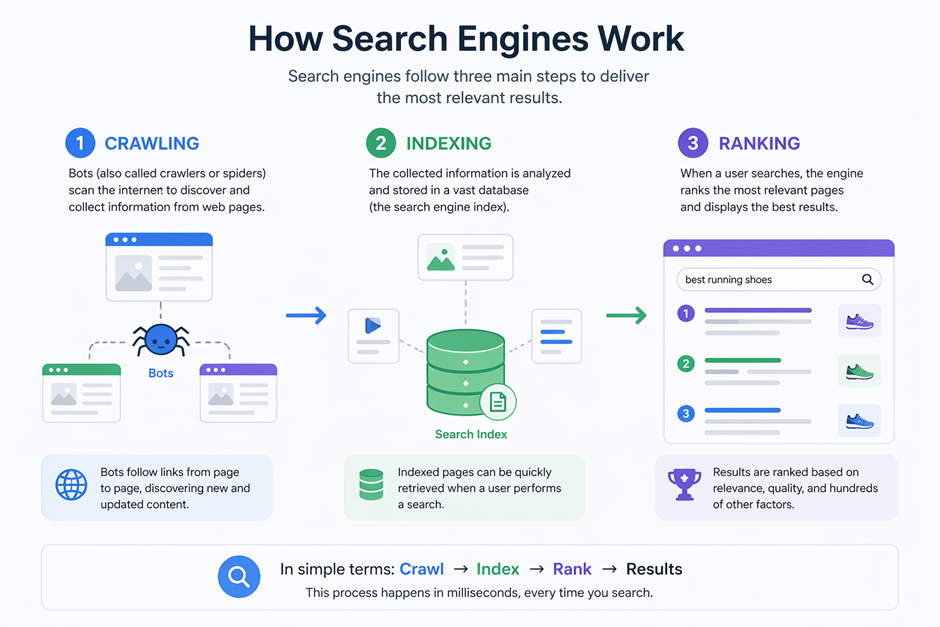
Search engines are designed with one primary goal: to deliver the most relevant and useful information in the shortest possible time. To achieve this, they follow a structured process that can be broken down into three key stages: crawling, indexing, and ranking.
Step 1: Discovery (Crawling)
Search engines use automated software programs called web crawlers (also called spiders or bots). Google’s crawler is called Googlebot. These crawlers constantly travel across the internet, moving from one webpage to another by following links.
When Googlebot visits a page, it reads everything on it the text, the headings, the images (via alt text), the links going to other pages, and the technical code behind the page. It then follows every link it finds and visits those pages too.
This is why internal linking (linking from one page of your site to another) is so important in SEO it helps crawlers discover all your pages.
Step 2: Processing & Indexing
After crawling, the information gets processed and stored in Google’s Search Index which is essentially the world’s largest database, storing copies of every webpage Google has ever crawled.
This process is similar to organizing a highly sophisticated digital library, where every piece of content is categorized in a way that allows for quick retrieval.
During indexing, Google analyses the content on each page to understand:
- What is this page about?
- What keywords does it use?
- What language is it in?
- Is the content high quality or thin?
- Who links to this page?
Step 3: Ranking
When a user enters a query, the search engine does not scan the entire internet in real time. Instead, it retrieves relevant pages from its index and ranks them based on multiple factors, including:
- Relevance — does the page match the search intent?
- Authority — how many quality websites link to this page?
- Freshness — when was the content last updated?
- User Experience — how fast does the page load? Is it mobile-friendly?
- Engagement — when people visit this page, do they stay or leave immediately?
Why this Matters for SEO
Understanding the crawl-index-rank process directly shapes how you build your website. If your pages are not crawlable (blocked by code), they cannot get indexed. If they are not indexed, they cannot rank. Every SEO decision site structure, page speed, internal links, sitemaps is rooted in making this three-step process work as smoothly as possible.
2. Objectives of SEO
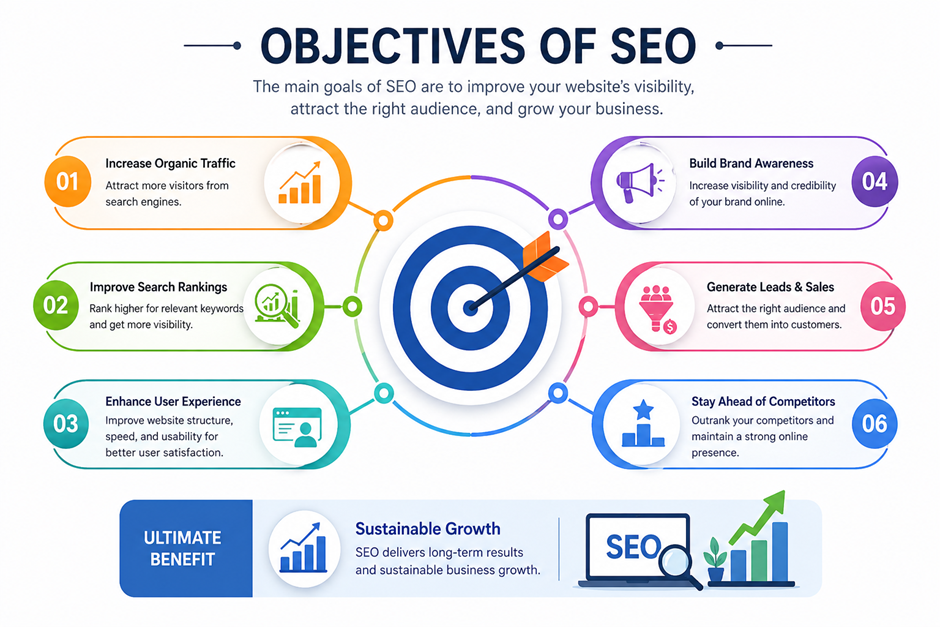
A small business owner spends weeks building a website. Every detail is carefully crafted the design looks modern, the content is thoughtful, and the product is genuinely valuable.
They launch it with excitement, expecting visitors to start coming in. Days pass. Then weeks. But nothing happens. No traffic, no inquiries, no sales.
Out of curiosity, they open Google and search for their own service. Page after page loads, but their website is nowhere to be found.
That’s when the realization hits:
Having a website is not enough being visible is what truly matters.
This is exactly where SEO marketing becomes essential.
1. SEO Makes Your Business Discoverable
In today’s digital landscape, most decisions begin with a search. Whether someone is looking for a product, a service, or simply information, their journey almost always starts on a search engine.
SEO ensures that your website appears at that exact moment when your audience is actively searching.
Unlike traditional marketing, which often interrupts users, SEO works differently. It places your business in front of people who already have intent. This makes your visibility not just broader, but also more meaningful.
2. SEO Builds Trust and Credibility
Think about your own behavior when you search online. You’re more likely to click on the first few results than scroll endlessly.
That’s because users subconsciously associate higher rankings with reliability and authority.
When your website consistently appears on the first page, it signals to users that your content is trustworthy and valuable. Over time, this builds credibility not just with search engines, but with your audience as well.
In a world full of options, trust becomes a deciding factor and SEO helps you earn it.
3. SEO Drives High-Quality, Intent-Based Traffic
Not all traffic is equal. What truly matters is attracting people who are genuinely interested in what you offer.
SEO brings in users who are already searching for specific solutions. This means:
• They are more engaged
• They spend more time on your website
• They are more likely to convert into customers
Instead of reaching a broad audience with uncertain interest, SEO connects you with the right audience at the right time.
4. SEO Delivers Long-Term and Sustainable Results
One of the biggest advantages of SEO is its long-term impact.
Paid advertising can generate quick traffic, but the moment you stop investing, the traffic disappears. SEO, on the other hand, continues to work for you even after the initial effort.
A well-optimized page can generate traffic for months or even years without additional cost.
This makes SEO not just a marketing tactic, but a sustainable growth strategy that compounds over time.
5. SEO Enhances User Experience
Modern SEO is no longer just about keywords it’s about creating a better experience for users.
Search engines prioritize websites that are:
• Fast and responsive
• Mobile-friendly
• Easy to navigate
• Rich in valuable content
By improving these aspects, SEO not only helps you rank higher but also ensures that visitors have a smooth and satisfying experience on your website.
And when users have a good experience, they are more likely to stay, explore, and take action.
6. SEO Supports Every Stage of the Customer Journey
SEO is unique because it doesn’t focus on just one stage of marketing it supports the entire journey:
• Awareness: Users discover your content through informational searches
• Consideration: They compare options and explore your offerings
• Decision: They take action, such as making a purchase or contacting you This makes SEO a powerful tool that works across the entire funnel, guiding users from curiosity to conversion.
3. Keyword Research in SEO
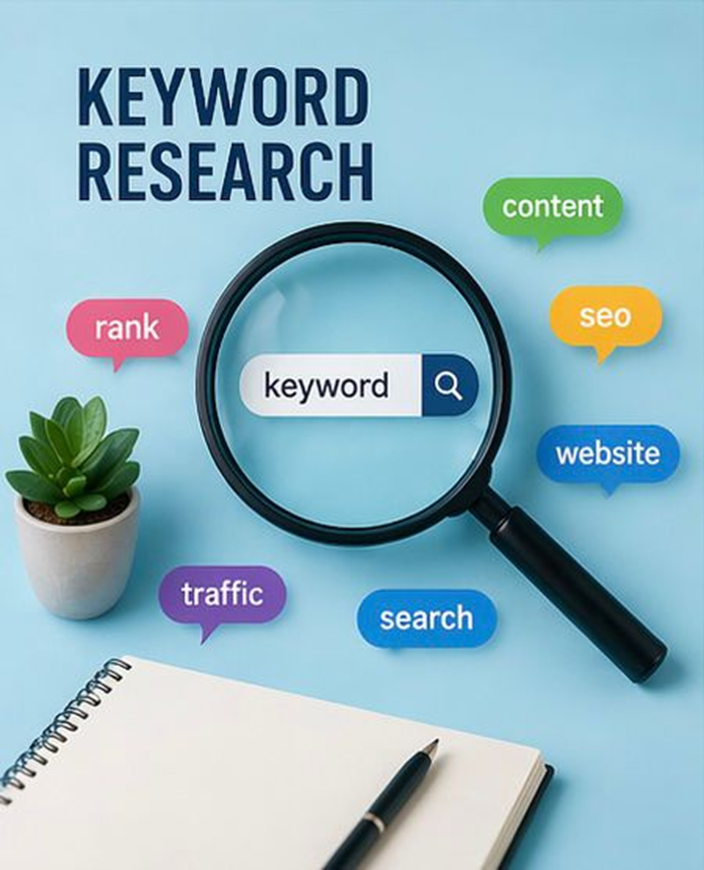
A content writer spends hours crafting a detailed blog. The research is solid, the writing is polished, and the design looks great. After publishing, they wait for traffic to come in. Days pass, nothing.
Later, they realize something crucial they wrote what they thought people would search, not what people were actually searching on Google.
That moment highlights a simple truth:
In SEO, success doesn’t start with writing it starts with understanding the right words.
This is where keyword research becomes the foundation of everything.
What is Keyword Research
Keyword research is the process of identifying the words and phrases that people type into search engines when looking for information, products, or services.
It helps you understand:
- What your audience is searching for
- How often they search for it
- How competitive those keywords are
In simple terms, keyword research connects your content with real user intent.
Why Keyword Research Matters
Without keyword research, your content is like a message sent without knowing the recipient.
With proper research, you:
- Target the right audience
- Increase visibility in search results
- Create content that answers real questions
- Improve your chances of ranking higher
It ensures that your efforts are not just creative but also strategic.
Types of Keywords
Short-tail Keywords (Head Terms)
- 1 to 2 words
- Very high search volume
- Very high competition
- Example: “flats Bangalore”, “digital marketing”
Long-tail Keywords
- 3 or more words
- Lower search volume individually
- Very low competition
- Very high intent
- Example: “2BHK flat for rent in Koramangala under ₹20,000”
Long-tail keywords are where most SEO wins happen especially for new or small websites. They are more specific, which means the people searching them are closer to taking action.
Local Keywords
- Include a location
- High intent for local businesses
- Example: “PG near Manyata Tech Park”, “digital marketing course in Bangalore”
How to do Keyword research (Step by Step)
Step 1 — Brainstorm Seed Keywords
Start with the most obvious terms that describe your business or content. If you run a tiffin service, seed keywords might be: home food delivery, tiffin service, homemade lunch.
Step 2 — Expand Using Tools
Use free tools like Google Keyword Planner or Google’s autocomplete feature to find related keywords and their search volumes.
Step 3 — Analyse Search Intent
For every keyword, ask what does the person searching this actually want?
- Informational intent — they want to learn something (“how does SEO work”)
- Navigational intent — they want to find a specific website (“NestNear login”)
- Transactional intent — they want to buy or take action (“book PG in Koramangala”)
- Commercial intent — they are comparing options (“best PG in Bangalore 2026”)
Step 4 — Analyse Competition
Search the keyword yourself. Look at the top 10 results. If they are all large authoritative websites with thousands of backlinks, that keyword is very hard to rank for. If you see small blogs and local business pages, you have a realistic chance.
Step 5 — Prioritise
Prioritise keywords based on three factors:
- Search volume — how many people search this monthly?
- Keyword difficulty — how hard is it to rank?
- Business relevance — if you rank for this, will it bring customers?
4. Benefits of SEO
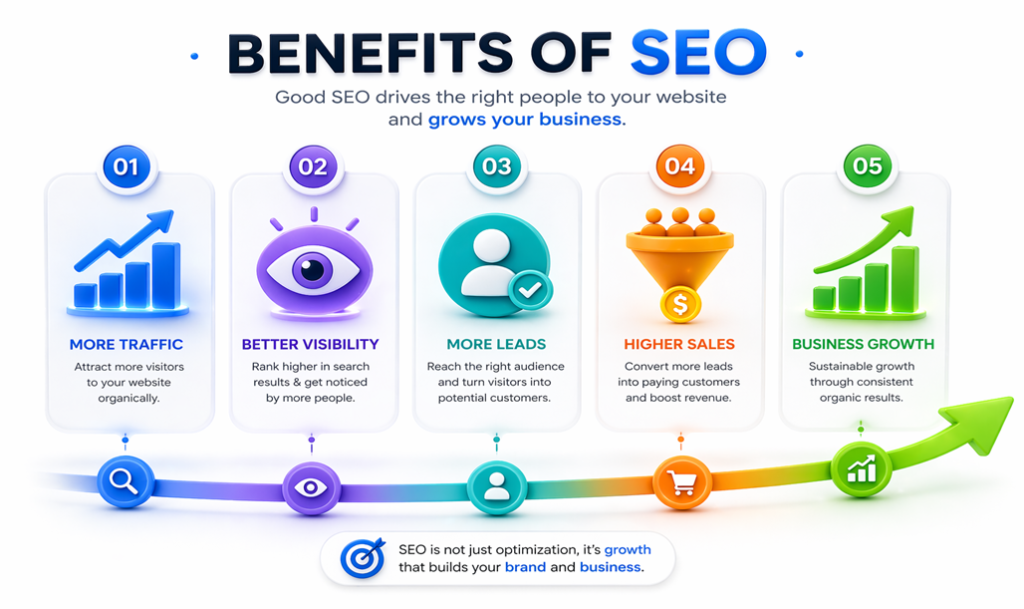
While the theoretical importance of SEO is well understood, here are the concrete, measurable business benefits that SEO delivers:
Benefit 1 — Free, Sustainable Traffic
Every visitor who arrives through organic search costs you nothing. Once you rank, the traffic is free. For a business spending ₹50,000 per month on Google Ads, achieving the same traffic through SEO represents a saving of ₹6 lakh per year every year, indefinitely.
Benefit 2 — Better Quality Leads
Organic search visitors convert better than almost any other traffic source. This is because they are actively searching for what you offer they have self-identified as potential customers before they even reach your website.
Studies show that SEO leads have a 14.6% close rate compared to just 1.7% for outbound marketing (cold calls, print ads). The difference is intent SEO captures buyers, outbound marketing interrupts everyone.
Benefit 3 — 24/7 Visibility
Your website never sleeps. A page optimised for “tiffin service near me” works at 2am on a Sunday just as effectively as it does at noon on a Monday. No sales team, no customer service agent, no additional cost.
Benefit 4 — Brand Awareness and Authority
Consistently appearing at the top of search results for topics related to your industry builds brand recognition. Even users who don’t click still see your brand name. Research shows that repeated exposure in search results increases brand recall significantly even without a single click.
Benefit 5 — Competitive Advantage
Businesses that invest in SEO early build a significant competitive moat. SEO authority compounds the longer you invest in it, the harder it becomes for competitors to overtake you. A website that has been publishing quality content and building backlinks for 2 years is extremely difficult for a new competitor to displace.
Benefit 6 — Local Business Growth
For hyperlocal businesses restaurants, PG accommodations, salons, clinics Local SEO is transformational. Appearing in the Google Maps “Local Pack” (the three businesses shown in map results) can drive more footfall than any other marketing channel.
A small business listed in the Google Local Pack receives on average 5x more calls compared to the same business without Local SEO.
Benefit 7 — Measurable, Trackable Results
Unlike traditional marketing (newspaper ads, hoardings, pamphlets), every aspect of SEO is measurable. You can track exactly how many people visited your site, which pages they read, what they searched to find you, how long they stayed, and whether they converted into customers. This data makes SEO continuously improvable.
5. How to Measure and Track SEO Success
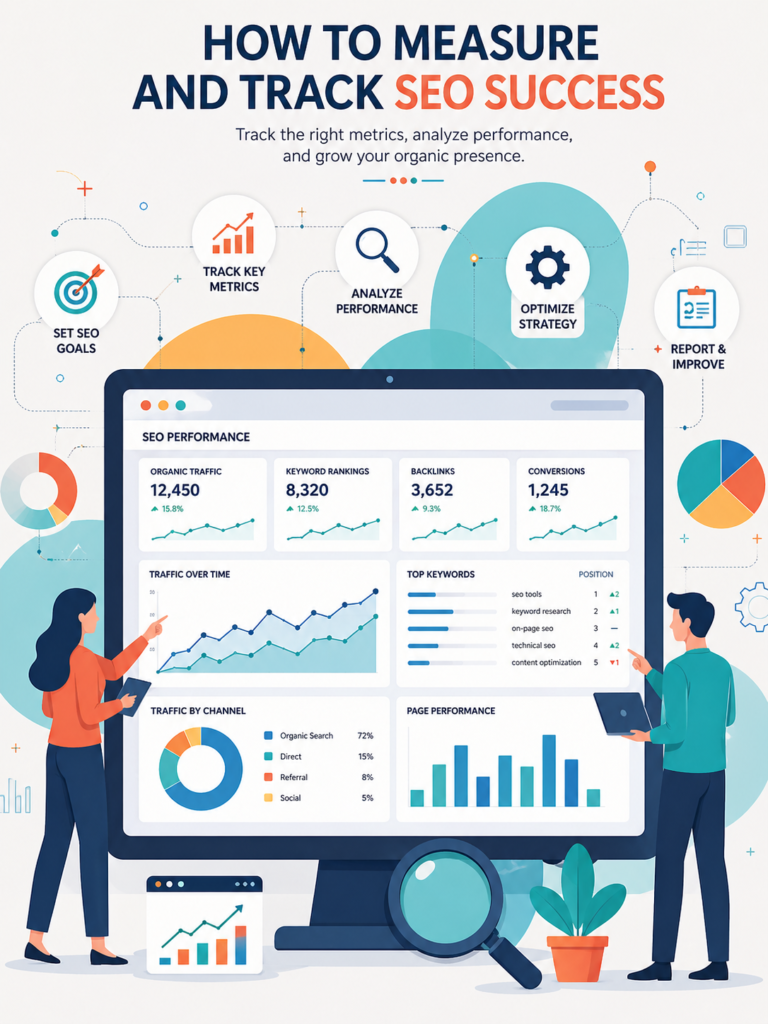
The analytics how you know if SEO is working
One of SEO’s greatest advantages over traditional marketing is complete measurability. Here are the key metrics and tools every business should use to track SEO performance.
Key SEO Metrics to Track
1. Organic Traffic
The number of visitors coming to your website from search engines. This is the most direct measure of SEO performance. Track it monthly and look for consistent growth over 6 to 12 months.
2. Keyword Rankings
Track where your website ranks for your target keywords. A jump from position 15 to position 5 for an important keyword can double or triple your traffic from that search term.
3. Click-Through Rate (CTR)
Out of everyone who sees your page in search results, what percentage actually clicks? Average CTR for position #1 is around 28%. If your CTR is lower, your title tag or meta description needs improvement.
4. Bounce Rate
The percentage of visitors who land on your page and leave without visiting any other page. A high bounce rate can signal that your content does not match what the user was looking for which hurts SEO rankings over time.
5. Domain Authority (DA)
A score from 0 to 100 that represents how authoritative Google considers your website overall. It is built primarily through backlinks from other respected websites. Higher DA means easier ranking across all your pages.
6. Backlinks
The number and quality of external websites linking to yours. More high-quality backlinks = higher authority = better rankings. Track both the quantity and the domain authority of sites linking to you.
7. Conversion Rate from Organic Traffic
The ultimate measure of all the visitors coming from Google, what percentage actually becomes a customer, subscriber, or lead? This connects SEO directly to business revenue.
Essential Tools for Measuring SEO
Google Analytics 4 (Free) Tracks all website traffic including organic search visitors, their behaviour on the site, pages viewed, time spent, and conversions.
Google Search Console (Free) Shows exactly which keywords your pages rank for, how many impressions and clicks you receive, your average position in search results, and any technical errors Google finds on your site.
Ubersuggest / Ahrefs / SEMrush (Paid) Advanced tools for tracking keyword rankings over time, analysing competitor SEO strategies, finding backlink opportunities, and conducting full SEO audits.
6. Types of Search Engine Optimization (SEO)
The complete picture the different dimensions of SEO
SEO is not a single activity. It is a collection of different disciplines, each addressing a different aspect of how search engines evaluate and rank websites.
Type 1 — On-Page SEO
On-page SEO refers to everything done directly on a webpage to improve its ranking. It is fully within your control.
Key On-Page SEO Elements:
Title Tag — The clickable headline shown in search results. It should include the primary keyword and be under 60 characters. Example: “1BHK Flat for Rent in Koramangala ₹18,000/month | NestNear”
Meta Description — The brief description shown under the title in search results. It should summarise the page content and include the primary keyword. Under 160 characters. This does not directly affect ranking but strongly affects click-through rate.
H1, H2, H3 Headings — Structural headings that tell both users and search engines what each section is about. Every page should have exactly one H1 (the main topic) and multiple H2s and H3s organising the content.
Keyword Placement — Primary keyword should appear in the title, first paragraph, at least one subheading, and naturally throughout the content. Never stuff keywords unnaturally Google penalises this.
Image Alt Text — Every image should have a descriptive alt text that includes relevant keywords. This helps rank in image search and makes your site accessible.
URL Structure — Clean, readable URLs work better than random strings of numbers. Example: nestnear.in/blog/best-pg-koramangala is better than nestnear.in/page?id=4829
Internal Linking — Linking from one page of your website to another helps both users navigate and crawlers discover all your pages.
Type 2 — Off-Page SEO
Off-page SEO covers everything that happens outside your website that influences your rankings primarily backlinks.
Backlinks are links from other websites pointing to yours. They are essentially votes of confidence. When a respected website links to your page, it tells Google that your content is trustworthy and valuable.
Key Off-Page SEO Activities:
• Guest posting — writing articles for other blogs with a link back to your site
• Digital PR — getting mentioned in news articles and online publications
• Social signals — shares and mentions on social media platforms
• Local citations — listings on directories like JustDial, Sulekha, Google Business Profile
• Influencer mentions — being referenced by respected figures in your industry
Not all backlinks are equal. A single link from a high-authority site like The Times of India is worth hundreds of links from unknown blogs.
Type 3 — Technical SEO
Technical SEO addresses the behind-the-scenes aspects of a website that affect how well search engine crawlers can access, read, and index the content.
Key Technical SEO Elements:
Page Speed — Google has confirmed that page speed is a direct ranking factor. Pages that take longer than 3 seconds to load lose rankings. Tools like Google PageSpeed Insights measure and diagnose speed issues.
Mobile-Friendliness — Since 2019, Google uses “mobile-first indexing” — meaning it primarily evaluates the mobile version of your website when deciding rankings. If your site is not mobile-friendly, you cannot rank well.
SSL Certificate (HTTPS) — Websites with HTTPS (the padlock icon in browsers) are preferred by Google over HTTP websites. It is now a basic requirement.
XML Sitemap — A file that lists all pages on your website and submits them to Google, ensuring every page gets crawled and indexed.
Robots.txt — A file that tells search engine crawlers which pages they are and are not allowed to crawl.
Structured Data / Schema Markup — Code added to pages that helps Google understand the content more specifically — for example, marking up a product with its price and rating so Google can show it as a rich result in search.
Core Web Vitals — Google’s specific set of user experience metrics including Largest Contentful Paint (how fast the main content loads), Cumulative Layout Shift (how stable the page layout is), and Interaction to Next Paint (how responsive the page is to user interactions).
Type 4 — Local SEO
Local SEO is the practice of optimising a business to appear in location-based searches. It is essential for any business with a physical location or one serving a specific geographic area.
Key Local SEO Elements:
Google Business Profile — Creating and optimising a free Google Business Profile is the most important step in Local SEO. It determines whether your business appears in the Google Maps “Local Pack” results.
NAP Consistency — Your business Name, Address, and Phone number must be identical across every online listing — your website, Google Business Profile, JustDial, Sulekha, and every directory.
Local Citations — Mentions of your business on local directories and review platforms build local authority.
Reviews — Quantity and quality of Google reviews directly influence local rankings. Businesses with more positive reviews consistently rank higher in local search results.
Hyperlocal Content — Creating pages and blog content specifically for each area or locality you serve — like NestNear creating separate pages for Koramangala, HSR Layout, and Whitefield — helps capture granular local search traffic.
Conclusion
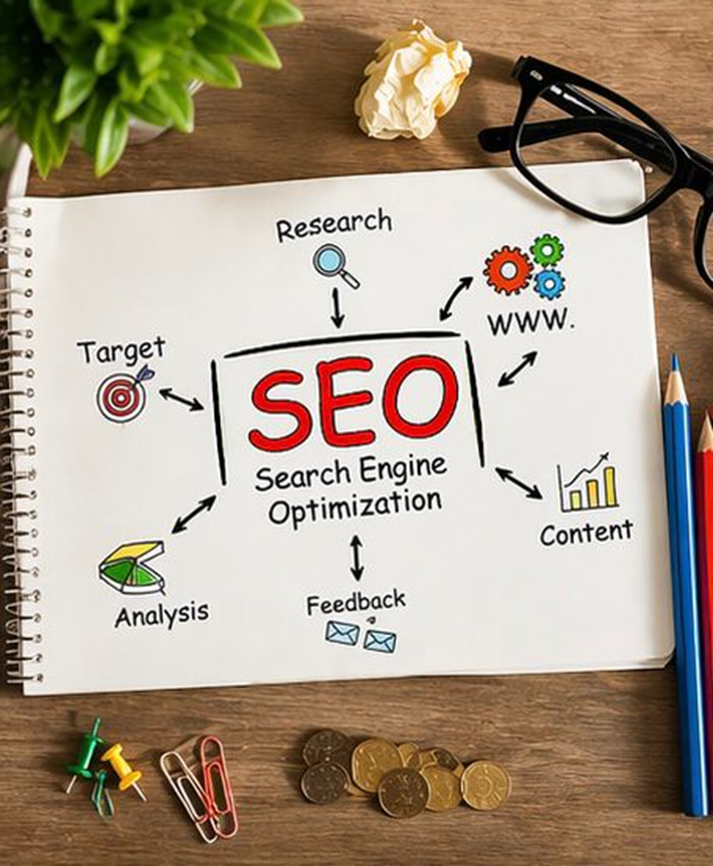
1. SEO is the process of making a website rank higher on Google and other search engines for relevant search queries without paying for ads.
2. Search engines work by crawling, indexing, and ranking content based on hundreds of signals including relevance, authority, and user experience.
3. SEO is important because it captures users at the moment of highest intent, delivers sustainable free traffic, and compounds in value over time unlike any paid channel.
4. Keyword research is the foundation of all SEO — identify what your target audience actually searches, focus on long-tail keywords, and always match search intent.
5. The four types of SEO — on-page, off-page, technical, and local must all work together for maximum results. Focusing on just one dimension leaves value on the table.
6. Track SEO success using Google Analytics 4 and Google Search Console. Monitor organic traffic, keyword rankings, click-through rate, and backlink growth consistently.
7. SEO is a long-term strategy — expect 3 to 6 months before significant results appear. But the compounding effect means the returns grow every single month without additional cost.
8. For businesses, SEO delivers the highest long-term ROI of any digital marketing channel — making it the foundation of any sustainable digital marketing strategy.
Drop a comment below and tell me what’s the first thing you’re going to try? I read every single comment and would love to cheer youhttps://mailchimp.com/marketing-glossary/seo/
FAQs
1. What is SEO and how does it work?
SEO (Search Engine Optimization) is the process of improving your website so it appears higher on search engines like Google when users search for relevant topics.
It works through three main steps:
- Crawling: Search engines scan your website using bots
- Indexing: Your content is stored and organized
- Ranking: Your pages are shown based on relevance and quality
In simple terms, SEO helps search engines understand your content and show it to the right audience at the right time.
2. How to practice SEO for beginners?
If you’re just starting, SEO can feel overwhelming—but it becomes manageable when broken into steps.
Begin with:
- Learning basic keyword research
- Creating helpful and relevant content
- Optimizing titles, headings, and meta descriptions
- Making your website mobile-friendly and fast
The key is consistency. Start small, focus on quality, and gradually improve your strategy as you learn.
3. How long does SEO take to work?
SEO is a long-term strategy, not an instant result.
Typically:
- Initial improvements can be seen in 3–6 months
- Strong results often take 6–12 months or more
The timeline depends on factors like competition, content quality, and how consistently you apply SEO practices.
Think of SEO like building a reputation—it takes time, but once established, it delivers lasting results.
4. What are common SEO mistakes?
Many beginners make mistakes that slow down their progress. Some of the most common ones include:
- Ignoring keyword research
- Using too many keywords (keyword stuffing)
- Publishing low-quality or duplicate content
- Not optimizing for mobile users
- Ignoring technical aspects like page speed
Avoiding these mistakes can significantly improve your chances of ranking higher.
5. Which factor is most important for SEO?
There isn’t just one factor—SEO works best when multiple elements come together. However, high-quality content is the most important foundation.
Search engines prioritize content that:
- Answers user queries clearly
- Provides real value
- Is easy to read and well-structured
Along with content, factors like backlinks, user experience, and technical optimization also play a major role.