
Introduction
If you’re a small business owner trying to grow online, you’ve probably asked yourself
Should I invest in SEO or paid ads first? Both are powerful digital marketing tools, but they work very differently and choosing the wrong one first can waste your budget and delay your growth.
In this post, we’ll break down how SEO and paid ads compare, and help you decide which one deserves your attention (and budget) first.
What Is SEO?
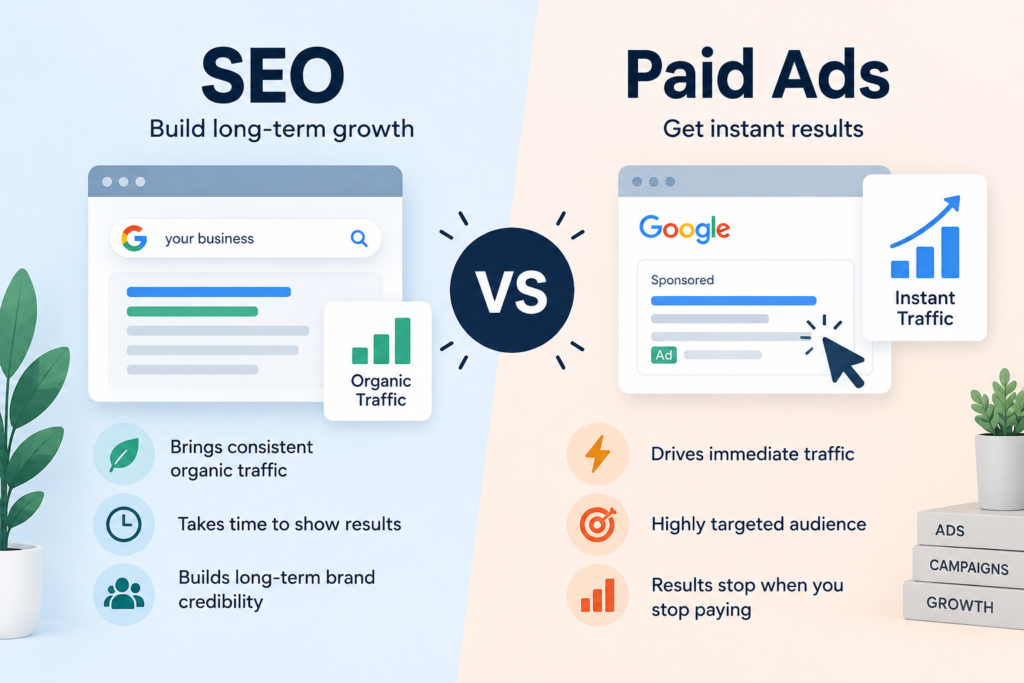
SEO (Search Engine Optimization) is the process of improving your website so it ranks higher in organic (unpaid) search results. This includes optimizing your content, keywords, site structure, and backlinks so that search engines like Google recognize your site as relevant and trustworthy.
Pros: Long-term, sustainable traffic; no cost per click; builds credibility; compounds over time.
Cons: Takes 3-6 months to show results; needs ongoing content work; rankings can shift with algorithm updates.
What Are Paid Ads?
Paid ads (like Google Ads or social media ads) let you pay to appear at the top of search results or in front of a targeted audience immediately. You bid on keywords or audience segments, and you’re charged per click or impression.
Pros: Immediate visibility; highly targeted by location, demographics, and interests; easy to measure ROI in real time.
Cons: Traffic stops the moment you stop paying; can get expensive in competitive industries; needs ongoing budget and management.
If you’re new to online marketing, you can also learn what digital marketing is in simple words.
SEO vs. Paid Ads: Key Differences
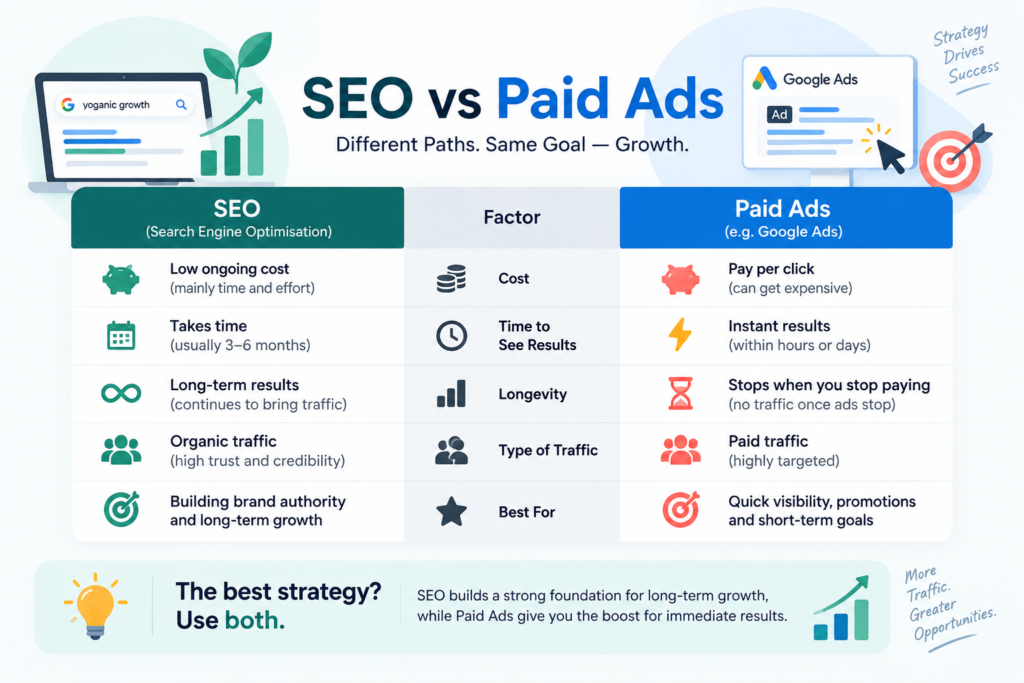
Time to results SEO is slow (months), Paid Ads are fast (days). Cost structure SEO is an upfront time/effort investment, Paid Ads are ongoing pay-per-click. Longevity SEO is long-term and compounding, Paid Ads stop when budget stops. Trust factor SEO feels more credible, Paid Ads feel less credible since users know it’s an ad. Best for SEO suits long-term brand building, Paid Ads suit quick wins, promotions, and launches.
So, Which Should You Invest In First?
Here is the honest answer: it depends on your business stage and your goals.
You should choose paid ads first if you need immediate traffic or sales, for example during a product launch. They also make sense if you are testing a new offer and need fast feedback, or if you have budget available but not much time to wait for results.
On the other hand, you should choose SEO first if you are building a long-term brand and want sustainable growth. SEO is also the smarter choice if your budget is limited and you cannot sustain ongoing ad spend, or if you are comfortable investing time now for a bigger payoff later.
The ideal approach, in most cases, is to use both. Many successful businesses run paid ads for quick wins while simultaneously building SEO in the background. As organic rankings improve over time, you can gradually reduce your ad spend and let SEO carry more of the traffic load, which lowers your overall customer acquisition cost.
On-Page SEO Factors That Influence Your Rankings
If you decide to prioritize SEO, either alone or alongside paid ads, it helps to understand exactly what search engines look at when ranking your pages.
Meta title is what appears in search results and browser tabs. Keep it under sixty characters and include your focus keyword. Meta description, usually under one hundred sixty characters, does not directly affect rankings but improves click-through rate. Your slug, or URL, should be short, readable, and include your focus keyword.
Keyword density is how often your keyword and its variations appear relative to total word count; aim for one to two percent, naturally. Keyword proximity means placing related keywords close together, while prominence refers to placing your keyword early, in the title, intro, and headers, where it carries more weight.
Image alt text helps search engines and screen readers understand your images. Word count signals depth, though quality always matters more than hitting a number. Content quality, meaning original and genuinely useful writing, is the top ranking factor today. Finally, avoid plagiarism entirely, since duplicate content can hurt your whole site’s rankings, not just one page.
Conclusion
There is no one-size-fits-all answer to the SEO versus paid ads debate. If you need quick results and have the budget available, start with paid ads they get you in front of customers within days and let you test what messaging works.
If you are playing the long game and want sustainable, cost-effective traffic, prioritize SEO instead it takes longer to pay off, but the results compound and don’t disappear the moment you stop spending. And if you can manage both at once, a combined strategy will almost always outperform either approach used alone: paid ads bring in traffic today while SEO quietly builds the foundation for tomorrow. The right mix ultimately comes down to your budget, your timeline, and how patient you can afford to be.
Not sure which strategy fits your business? Reach out, and let’s build a digital marketing plan tailored to your specific goals.
Frequently Asked Questions
Which is better for a brand-new business with no online presence?
Paid ads are often better in the very early stage since they generate visibility instantly. SEO can then be built alongside it as a long-term growth engine once you have initial traction.
- Is SEO better than paid ads?
Neither is universally better. SEO delivers long-term, compounding value, while paid ads deliver immediate, short-term results. The right choice depends on your timeline, budget, and business goals. - How long does SEO take to show results? Most businesses start seeing meaningful organic traffic growth within three to six months, though this varies by industry competitiveness and content consistency.
- Can I run SEO and paid ads at the same time? Yes. Many successful businesses use paid ads for immediate visibility while building organic rankings in the background for long-term growth.
- Which option is more cost-effective in the long run? SEO tends to be more cost-effective over time since traffic doesn’t disappear when you pause spending, unlike paid ads, which stop the moment your budget runs out.
- How much budget do I need to start with paid ads? It varies by industry and competition, but most small businesses start testing with a modest daily budget and scale up once they see which campaigns deliver a positive return.
- Do I need a website to run SEO or paid ads? Yes, for SEO you need a website to optimize. Paid ads can technically run without one, using a landing page or social profile, but a proper website improves conversion rates for both.
- What happens if I stop doing SEO after ranking well? Your rankings can gradually decline, especially if competitors keep publishing fresh, optimized content, since SEO rewards ongoing effort rather than a one-time push.
- Is paid advertising risky for a small business? It can be if campaigns aren’t monitored closely. Poor targeting or weak ad copy can burn through budget quickly, so start small, track results, and scale what works.
- How do I know if my SEO efforts are working? Track organic traffic, keyword rankings, and conversions over time using tools like Google Search Console and Google Analytics. Improvement is usually gradual, not overnight.